Cities and Communities
Engineers in Development Work
How Australian consulting teams deliver water, roads and institution-building projects across Asia and the Pacific, and who funds them.
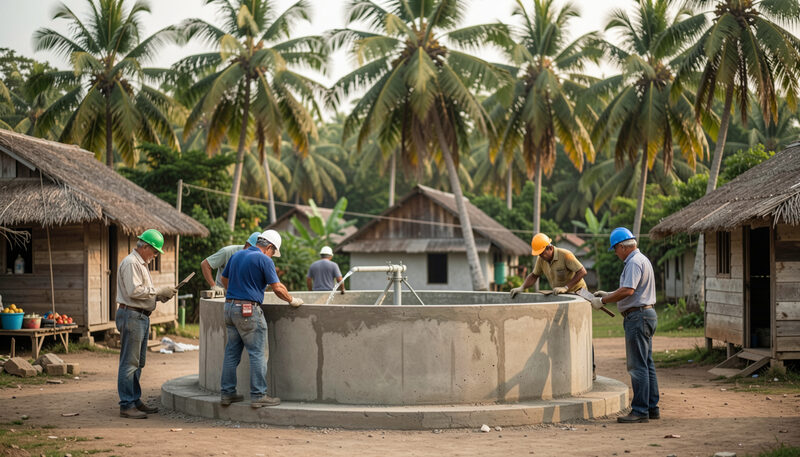
For more than half a century, Australian engineers, planners and project managers have delivered infrastructure and institution-building projects across Asia and the Pacific, funded mostly by the Australian aid program and the multilateral development banks. It is a distinct market with its own funding cycles, procurement rules and professional disciplines, and it has been one of the steadiest sources of overseas work for Australian consulting firms.
Who pays for the work
Three funders dominate. The Australian aid program, administered through the Department of Foreign Affairs and Trade, commissions projects directly and through managing contractors. The multilateral development banks, principally the Asian Development Bank and the World Bank, lend to governments and procure the consultants who design and supervise the works those loans fund. Partner governments themselves hire Australian firms where local capability is thin or where donors require independent oversight.
The mix shapes the work. Aid-funded projects carry development objectives alongside engineering ones: a rural road project is also expected to improve market access for poor households, and a water project is also an exercise in building the local utility's capacity to run itself. The engineers who thrive in the sector learn to hold both purposes at once.
What the projects look like
The sector's work divides into physical delivery and institutional support. On the physical side, Australian teams design and supervise rural roads, bridges, water supply and sanitation systems, ports and buildings, often in environments where climate, materials supply chains and maintenance capacity differ sharply from home. On the institutional side, longer-term programs embed advisers inside partner government agencies to strengthen budgeting, procurement, asset management and service delivery.
Managing contractors run the largest programs on behalf of the aid program: multi-year facilities that procure and administer dozens of sub-projects across a country or sector. The model concentrates risk management, safeguards and reporting in a single accountable contractor, and it has been the standard Australian delivery vehicle in Papua New Guinea, Indonesia, the Pacific and Timor-Leste for two decades.
The procurement rules differ
Development work is bought through international competitive processes with their own conventions. The development banks run quality-and-cost selection, where a technical proposal is scored before the financial envelope is opened, and the balance between the two scores decides the winner. Aid program procurement uses its own tender and grant mechanisms, published on the AusTender system like other Australian government business.
Safeguards are non-negotiable and heavier than domestic equivalents. Environmental and social safeguard frameworks, child protection standards, fraud control and counter-terrorism vetting apply to every funded project, and compliance failures end contracts. The documentation burden is correspondingly real: a development project typically carries more reporting per dollar than its domestic equivalent.
Why Australian firms hold a niche
The sector rewards specific capabilities. Australian firms carry credibility in the Pacific and in parts of Asia built over decades of continuous presence. English-language technical standards and contract traditions align with the development banks' systems. Time zones make same-day working possible across the region in a way European and North American firms cannot match.
The work also flows both ways. Engineers who cut their teeth on remote-area water systems or asset management in partner countries bring back skills that domestic practice values: designing for maintenance poverty, working with informal institutions, delivering under uncertainty. The career path it opens sits inside the broader picture described in a career in consulting engineering.
How a project actually runs
A typical aid-funded infrastructure project passes through a recognisable cycle. The funder and partner government agree a concept; a design team produces feasibility and detailed design against the bank's standards; procurement follows the funder's rules with international advertising; and a supervision consultant is engaged separately from the builder to certify the works. Australian firms appear at every stage, sometimes inside one contract and sometimes spread across several.
Local partnership is now a condition of credibility, not a courtesy. Firms that win consistently build genuine partnerships with local companies, staff projects with national engineers rather than flying teams in and out, and treat the transfer of capability to the partner agency as a deliverable measured alongside the concrete. The evaluations reward it: programs that built local capacity outlast their funding; those that delivered assets alone often see them decay.
The honest limits
Development work is not domestic engineering transplanted. Payment cycles are slower and contractual recourse thinner. Political and security risk is a real line in every project budget. The evaluation literature on aid effectiveness is genuinely mixed, and practitioners who last in the sector learn to read it rather than recite the mission statement.
Program evaluations published by the funder's own evaluation office are the most honest public record of what works. They are candid documents by design, and they reward reading before judging any program's reported success.
Where it connects at home
The disciplines are the same ones this journal covers domestically. The water systems draw on the planning described in Water and Environment, the roads follow the same lifecycle as how a road project gets built, and the firms doing the work are the same ones whose service lines are mapped in The Consulting Profession. Development consulting is not a separate profession; it is the same profession practised under different funding rules.