Water and Environment
How Utilities Plan for Drought
Inside Australian drought planning: yield modelling, demand management, recycled water, desalination and the trigger points that matter.
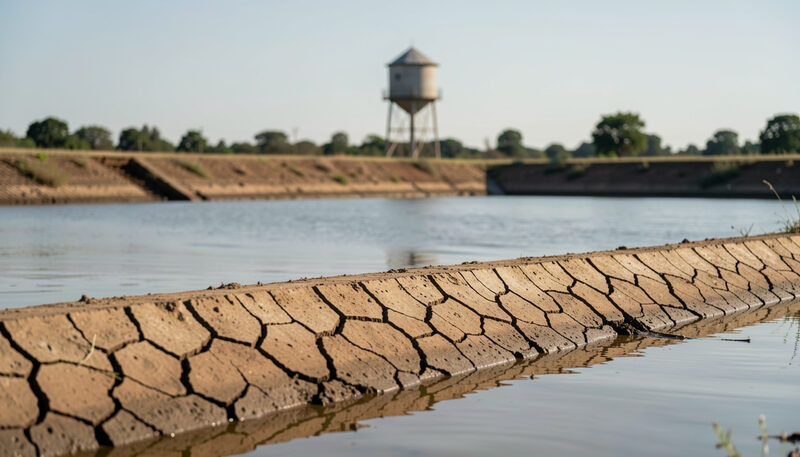
When an Australian water utility plans for drought, it is not forecasting next summer. It is stress-testing a city's supply against decades of hypothetical dry sequences, then deciding which measures to build, which rules to pre-approve and which triggers will activate each one. The framework was rebuilt after the Millennium Drought and it now shapes every serious water security plan in the country.
Why the old arithmetic failed
For most of the twentieth century, water planning assumed that historical rainfall records described the range of the possible. Dams were sized against the worst drought on record, with a margin. The Millennium Drought, which ran in parts of the south-east from the late 1990s to 2010, broke the assumption twice over: it lasted longer than the recorded droughts the models had been built on, and it arrived with a temperature regime that reduced runoff beyond what rainfall figures alone predicted.
Storage levels in Melbourne fell below 30 per cent. Brisbane came within reach of emergency supply measures. Perth had already moved earlier, after runoff into its dams collapsed in the 1970s and never recovered. The policy response in each city shared a shape: diversify the sources, regulate demand before it becomes an emergency, and build the drought-proof option before it is needed rather than after.
The yield model at the centre
Modern water security planning runs on stochastic modelling. Instead of asking what happened in the past, utilities generate thousands of plausible climate sequences, some drier than anything recorded, and simulate how the system performs in each one. The output is not a single forecast but a distribution: the probability that storage falls below a given level in a given year under a given set of measures.
That modelling defines the concept planners call yield: the demand a supply system can meet while keeping the probability of severe failure below an agreed threshold. A city's yield is not fixed. It rises when a new source is added, when losses are reduced, or when the community accepts a higher level of restriction as normal. Every major investment decision is framed as buying yield at a cost per megalitre.
Demand is a supply measure
Restriction regimes are designed before the drought, not during it. Each utility publishes a staged framework: permanent water-saving rules at the base, then escalating stages that limit garden watering, car washing and pool filling as storage crosses defined trigger levels. The stages are pre-approved by government so they can be activated in days rather than debated in a crisis.
Permanent efficiency measures sit underneath the emergency stages. Dual-flush toilets, efficient showerheads and changed garden habits cut per-capita demand in Melbourne and Brisbane by roughly a third across the drought decade, and much of that saving persisted after the rain returned. A litre saved permanently is yield bought without concrete.
Desalination as insurance
Every mainland state capital except Brisbane now operates a seawater desalination plant, and Sydney, Melbourne and Perth's plants are large enough to supply a substantial share of demand. They are expensive to run, so they are deliberately run rarely: the economics only work when the plant is understood as an insurance policy whose premium is paid to keep supply independent of rainfall.
The ordering matters. Desalination sits behind recycling, groundwater and demand measures in most portfolios because its cost per megalitre of regular yield is higher. Its value is that it is the only major source whose output does not fall when the rain does, which is exactly the property a drought reserve needs.
Recycled water and the harder sell
Purified recycled water is technically capable of closing the loop entirely, and Perth's groundwater replenishment scheme shows it working at scale: treated wastewater is purified to drinking standard and recharged into the aquifers the city draws from. Elsewhere, recycled water supplies industry, irrigation and dual-pipe suburbs rather than drinking taps, largely because of public acceptance rather than treatment limits.
The lesson utilities drew is that the technical case is the easy half. Schemes that succeeded invested years in community engagement and regulator confidence before construction. Schemes that tried to shortcut that work, notably in Toowoomba in 2006, were voted down even when the engineering was sound.
The regional difference
Capital city strategies get the coverage, but the drought problem bites hardest in regional systems: towns on single sources, irrigation districts whose allocations collapse first, and small utilities without the revenue base for big insurance projects. State programs for town water security, pipeline interconnections and emergency carting protocols are the regional expression of the same framework, run on thinner budgets against the same mathematics.
Reading a water security plan
Every major utility publishes its plan: Melbourne's water supply and demand strategy, Sydney Water's long-term planning, the SEQ Water Grid documents in Queensland. The documents that reward reading are the trigger tables and the options sequencing. They show which measure comes next, at what storage level or demand threshold, and what it would cost per megalitre. That is the honest map of a city's real choices, and it is public.
The approvals pathway any of these projects must still pass is covered in the guide to environmental approvals for major projects, and the firms that run the modelling sit inside the profession described at what a consulting firm does.